
Wheels of Fortune: The Gold Rush Bicycle Story
The role of bicycles in the Alaska Gold Rush era.

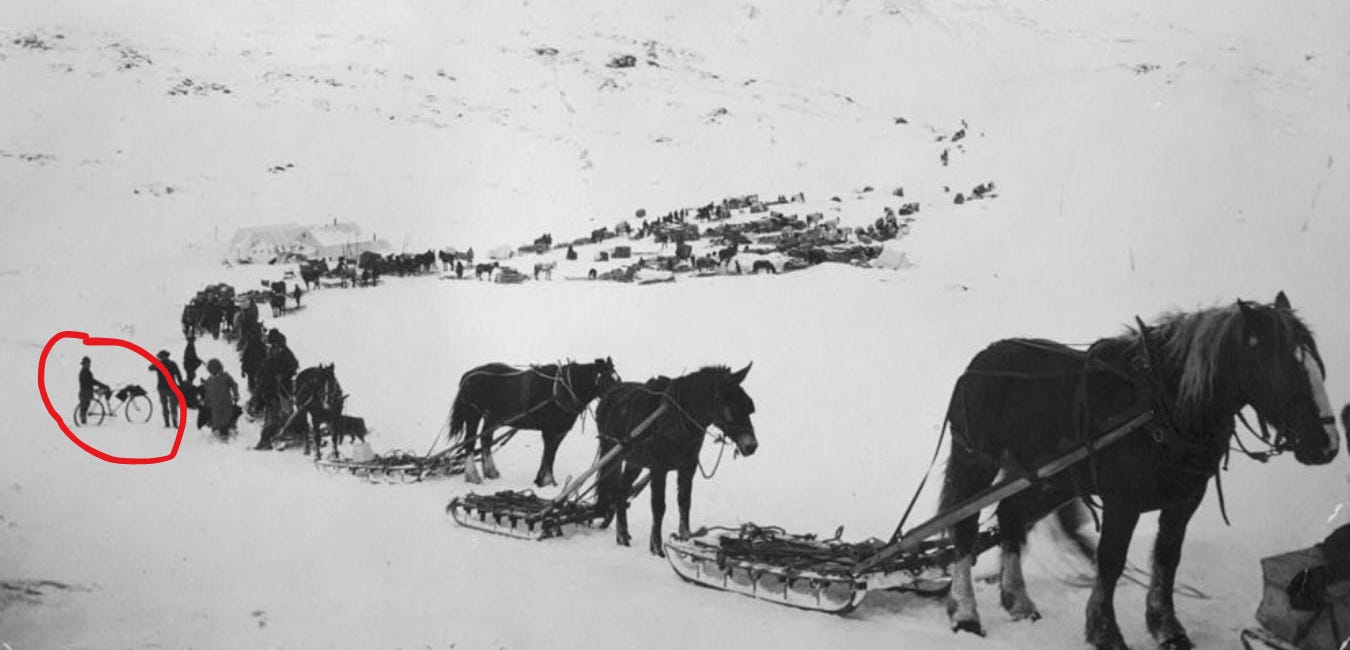
Notice the man with the bicycle in the red circle.
Let’s use a bicycle to get to the Klondike gold fields.
In 1896, the whole world was crazy for bicycles, and from 1896 to 1899, the Klondike gold rush was in full swing. Some stampedes looked to bicycles, or a “wheel” as bicycles were also called, to carry the supplies needed to enter Canada and head for the gold fields.
Peddling Through Peril: The Two Hundred Pound Challenge
In the late 1800s, bicycles were not light, and some tires were made of solid rubber.
However, stampeders with bikes were an inventive lot. And by adding frames to their bikes, they could carry loads as heavy as two hundred pounds.
Yes, You Can Share This Edition
And when you do, your friends and family will be so happy that they will send you on an all-expense-paid, bicycle trip around the world. Of course, someone else will peddle the bike, while you sit back and enjoy… well, it could happen.
Biking Over Those Wilderness Trails
No, there were no bike paths on the trails, but two early cyclists from the Brooklyn, New York Bicycle Club rode their wheels from Dawson City in the late 1800s and discussed creating a bike path to the Klondike. That idea never became a reality.
In the meantime, those using bikes on the trail rode along in the tracks left by dog and horse-drawn sleds. Plus, bicycles were faster on the trail, and you didn’t have to feed a bicycle.
A Tale of Two Passes
No bicycle could navigate the steep Chilkoot Trail to get to the Klondike. But it was somewhat possible on the White Pass, and a few were reported to have completed that trip.
Mr. W.J. Terry was the first known bicyclist to make it from Skagway to Dawson in March 1899. According to Terry, it took him 8 days.
During Terry’s adventure, he patched a flat tire by pouring water into the hole. Then, when it froze, he was able to ride again. Can you imagine that?
Gold Rush Rides: The Hazards of Biking to the Gold Fields
Riding a bicycle during the gold rush in Alaska came with challenges, including flat tires, frozen bearings, and exhaustion.
Edward Jesson wrote about bicycling on a trail at a temperature of 48 degrees below zero.
“The rubber tires on my wheel were frozen hard, as stiff as gas pipe. The oil in the bearing was frozen, and I could scarcely ride it. My nose was freezing, and I had to hold the handlebars with both hands, not being able to ride yet with one hand and rub my nose with the other.”
Peddle to the Gold Fields
During the Alaska Gold Rush, Seattle newspapers reported an increase in bicycle sales as stampeders headed to Dawson.
In 1900, the Argus reported as follows:
“Local dealers report that the success of cyclists on the trail (in the Alaska Gold Rush) has caused this branch of their trade to change from a mere experiment to a steady growing demand. Scarcely a steamship sails for the north that does not carry bicycles.”
Too Many Wheels
By around 1903, Dawson had so many bicycles around town that they were considered a nuisance.
Gold Fever, Skagway, and Soapy Smith
by Michael R. Dougherty of Alaska Stories and Anchorage Memories.
Adventure waits: A thrilling tale set in the heart of the Alaska Gold Rush.
Gold Fever, Skagway, and Soapy Smith is an adventure-filled short story that takes you to the gold strike, the rough town of Skagway, Alaska, and face-to-face with the notorious Soapy Smith.
Take a look at Gold Fever, Skagway, and Soapy Smith and get ready for an Alaska adventure.
Connect with Mike and Mary Jane

Can you imagine how hard it must have been for the stampeders who used bicycles to get to and from the gold fields?
Do you have a comment about this edition, Wheels of Fortune: The Gold Rush Bicycle Story?
You can also get in touch by replying to this email.
Until Next Time
Mike and Mary Jane
Alaska Stories