
Sitka, Alaska Totem Story
And a look at Sitka National Historical Park

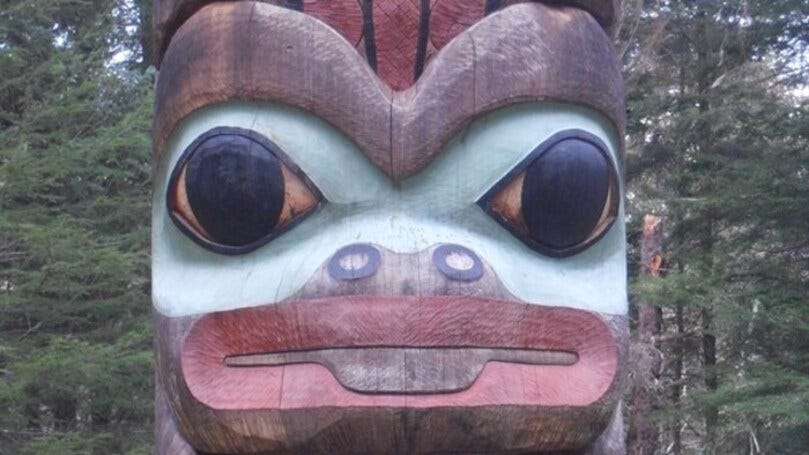
NPS photo
Alaskan natives look to animals for inspiration. For them, an animal has their own spiritual story.
Totem poles are often used to represent an animal.
What Does the Dictionary Say?
The word totem is a noun. A totem is an emblem or a badge that features an animal or a plant. Each totem represents a family, clan, or tribe.
Golden Age of Totem Carving
1830 to 1880 is considered the golden age for totem carving.
Most Alaska totems were created using Western Red Cedar and, on occasion, Yellow Cedar. The reason has to do with both trees being decay-resistant.
Haida and Tlingit artists in southeast Alaska carved totems with traditional tools made of stone, bone, or beaver teeth. Later, because of trading, metal tools were introduced, and carvings became more intricate.
Yes, You Can Share This Edition
And when you do, your friends and family will be so happy that they will carve a totem that represents you… Well, it could happen.
Alaska Governor John Brady
When Alaska was purchased from Russia in 1867 for $7.2 million dollars, many considered the purchase to be a mistake.
Back then, “Seward’s Icebox” and “Seward’s Folly” were two of the names given to the purchase.
So Governor Brady decided to start showcasing Alaska.
Around 1903, Brady had 15 original totem poles collected from Haida and Tlingit villages on Prince of Wales Island in southeast Alaska.
Those poles were then displayed at a 1904 Exhibition in St. Louis and a 1905 Exhibition in Portland.
The Totems in Sitka
In 1906, the totems returned to Alaska where they found a home in Sitka.
There, the totems were repaired and refurbished, then put on display in what is now the Sitka National Historical Park and the Totem Trail.
The Sitka National Historical Park is located in a rainforest of giant spruce trees. Established in 1890, the park covers 113 acres and is the oldest federally designated park in Alaska.
BONUS
There is much more to this story.
Take a look at the Sitka National Historical Park and discover.
You can also visit this Wikipedia look at the Sitka National Historical Park to learn more.
From Our North Stars (that’s you)

From our look at Alaska Firsts
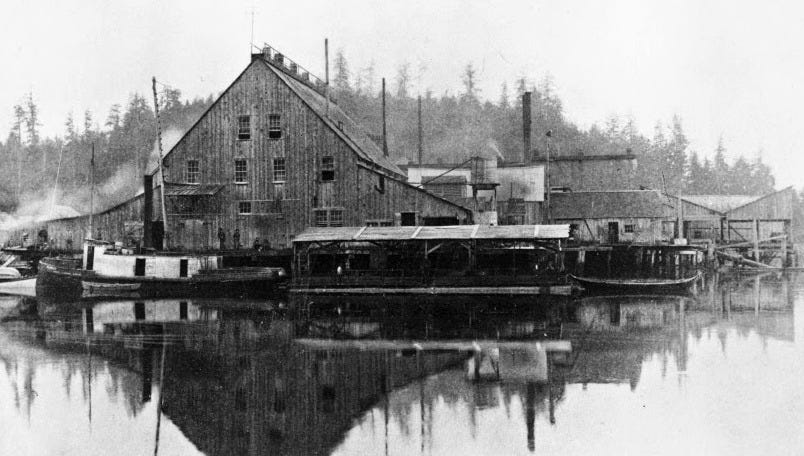
The Klawak Cannery was the first salmon cannery in Alaska. Located on Prince of Wales Island.
Jerry was there:
“Keep up the good work. I spent a few years up there.
1953 was the start when, after the last salmon was canned, they zipped her up until the first salmon arrived in the spring. Of course, the winter fishery of shrimp was going strong in the Petersburg and Wrangell areas. All local employees.
I moved my family to Wrangell, where I installed the first automated shrimp peeler in Alaska in 1956. We canned the shrimp. The other shrimp plants were hand peelers, and the market was all fresh. I could go on and on about the fishing industry. All of it.”
Connect with Mike and Mary

Our look at Alaska totem poles and the Totem Trail in the Sitka National Historical Park has been fascinating.
Do you have a comment?
You can also reply to this email.
Or, you can Contact Us with comments, questions, or a hello.
Until Next Time
Mike and Mary
Alaska Stories.com
Great story/history as usual!