
Kodiak, Alaska Tsunami, 1964
An incredible force of nature

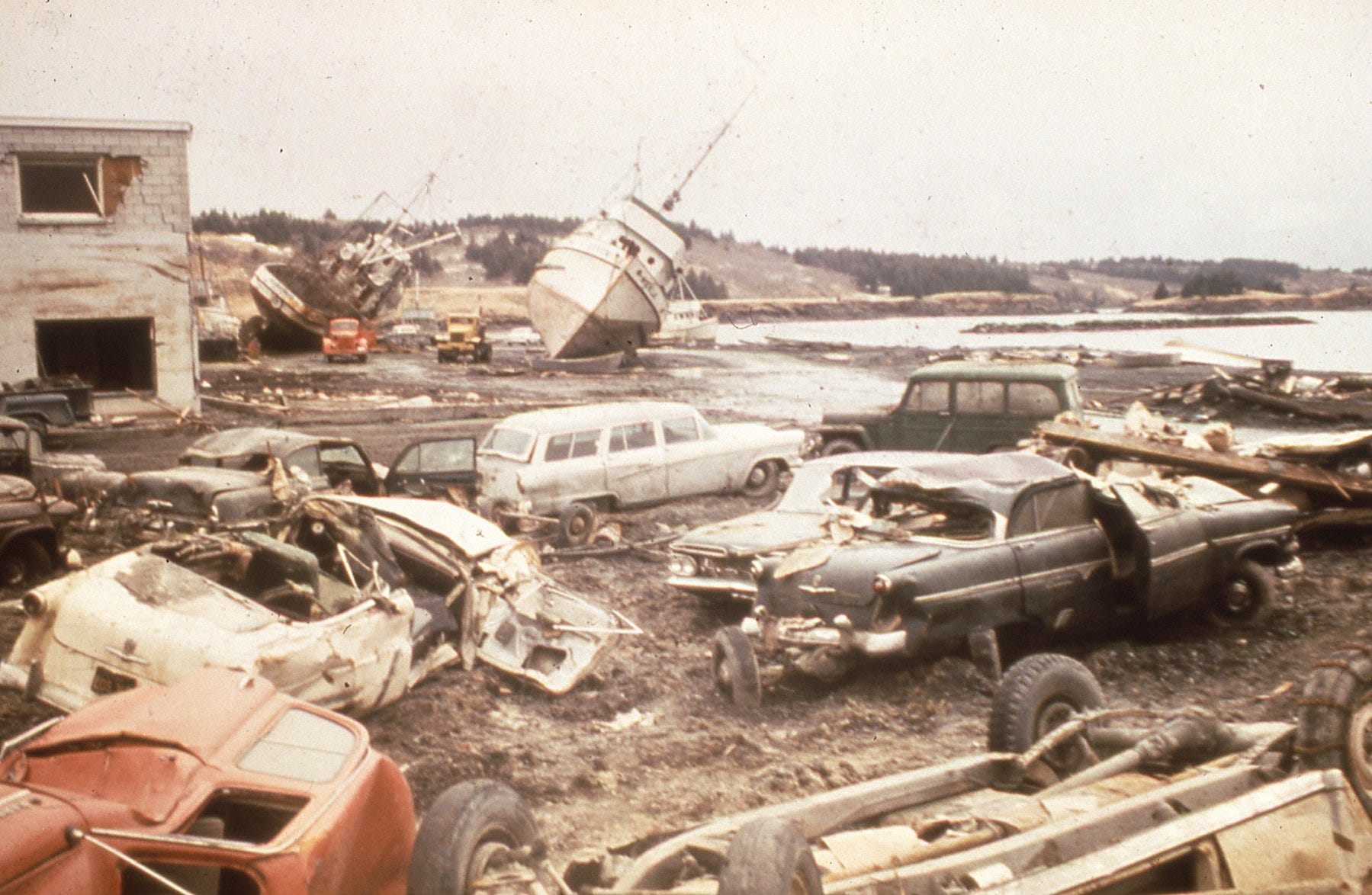
In 1964, Alaska was violently shaken by a 9.2 earthquake that lasted for 5 minutes.
The island of Kodiak, Alaska, is located in the Gulf of Alaska, about 250 air miles from Anchorage. The second-largest island in the United States, Kodiak, is only smaller than Hawaii.
During the 1964 earthquake, the downtown area northeast of the island sank almost 6 feet. The commercial fishing harbor was destroyed. More than 125 structures, including canneries and warehouses, were devastated.
Shortly after the quake, and because of the potential for a tsunami, everyone in the low-lying areas of Kodiak was told to quickly head for higher ground.
At least 10 waves struck Kodiak about 30 to 90 minutes apart. The tsunami waves continued for 11 hours.
The First Tsunami Wave
Around 40 minutes after the quake had stopped, except for violent aftershocks, the first tsunami wave hit Kodiak. It tore apart the waterfront and the downtown area. Fishing boats were left piled up on what remained of the breakwater.
The Second Wave
One hour later, a larger and stronger wave hit Kodiak. The devastation continued.
The Largest Wave
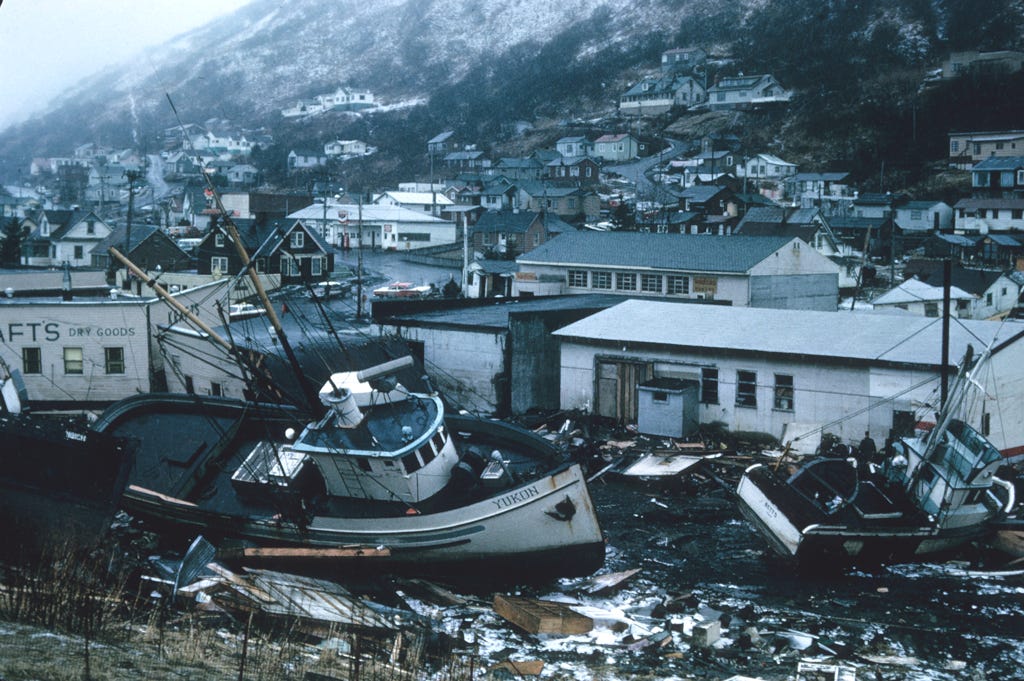
At around 10 pm, a 30-foot-tall wall of water struck the area. It sent huge boats crashing into downtown shops.
It destroyed the docks, canneries, and waterfront warehouses.
By morning, the boat harbor was gone.
Yes, You Can Share This Edition
BONUS
What was it like when the tsunami hit Kodiak?
Author Jerry Tilly was working aboard a boat in Kodiak and wrote a fascinating story about what he experienced on that day.
Here is part of his story:
“We were near the nonexistent entrance of the boat harbor trying to lasso another boat when the northeastern wave hit us and drove us sideways into the southwestern wave, and the combination of the two forces generated a giant whirlpool.
We were now going backwards with the main engine in full forward position in this swirling vortex with about a ten-degree list. The skipper told me to go down and drive that wedge back into the throttle, which I did in record time. The skipper had the wheel hard over to no avail.
There was a red house on the hill just north of the city dock that had been washed from its foundation and was floating along with all the other flotsam; only this house had somehow managed to enter the swirling vortex inside the Fortress. It started to break up and disappeared right before our eyes. We could look right down into this black hole.”
You can read the entire 1964 Alaska Earthquake Tsunami story right here.
Don Suryan and the Fishing Boat, “Shafto”
by Cindy Suryan,
former Anchorage, Alaska TV news anchor and talk show host
Good Friday, March 27, 1964, wasn’t a day that was talked about much in our household. My father, Don Suryan, found it difficult to share what it was like to survive a tsunami. He was part of a family with a long history of fishing and processing the Alaskan waters. He would spend months in Kodiak, AK while the rest of the family was in Anacortes, WA. That all changed after the events of that Good Friday.
My dad and his crew of the “Shafto,” were settled in a cove, working on their gear. As Dad entered the captain’s quarter’s he heard a voice tell him to get to town. As strange as it may sound, he felt he needed to heed that warning. He told his brother, Bill Suryan, and the rest of the crew, to get ready to go. The crew wasn’t sure why, but they followed the captain’s orders. When they arrived back to the Kodiak Harbor, the Great Alaska Quake happened. Dad knew what was coming next so they headed back out to deeper water to try to save their vessel and their livelihood.
From what I understand, they were followed by other boats heading out of the channel and witnessed those who couldn’t make it because the water had receded. One of those was a very large ship and unfortunately, it couldn’t help but come down on top of a smaller boat. Crushing it.
The Shafto did make it to the deeper water, but what those on board witnessed would be burned in their memories. Details are sketchy because dad found it very hard to talk about. As they rode it out, I remember dad saying that there was debris from the town and bottles of liquor (from the damaged liquor stores in Kodiak) floating all around them. They knew the news wouldn’t be good, but they managed to survive it all.
I found an old Kodiak City Hall Bulletin from April 10, 1964. It stated that dad and his crew of the Shafto along with the Wren W and the Cindy W were among the first to get back to sea and start fishing for Dungeness Crab. The boats and the processors got the fishing industry back in business in just weeks.
An airplane pilot friend of dad’s later told him that he flew over the cove the Shafto had been anchored in before the tsunami. He told him that their boat would have been kindling had they stayed. Chilling to think about.
Dad moved us all up to Kodiak after this. He wanted his family with him. As a young girl, I remember arriving to a downtown area that was destroyed. Muddy streets, boardwalks for sidewalks and a fishing boat lying on its side in the school playground. We were all together though and that’s all that mattered.
Our thanks to Jerry Tilley and Cindy Suryan for sharing these fascinating stories.
From Our North Stars (that’s you)
From our Independence Mine Story edition
Eric shared this:
“My Dad work at Independence Mine in 1941. He was a mining engineering student at the University of Alaska. He is in the picture of the miners standing in the mouth of the mine on display at the park headquarters. (The only one with glasses.)”
Connect with Mike and Mary
As survivors of the great Alaska Earthquake of 1964, our memories fade with each passing year.
But sharing personal stories like what happened in Kodiak, during the quake and the devastating 11-hour onslaught of the tsunami that followed, is important for us and for generations to follow.
Do you have a comment?
You can also reply to this email.
Or, you can Contact Us right here.
Until Next Time
Mike and Mary
Alaska Stories
My uncle DeWitt Fields and his family have lived and fished in Kodiak since the mid-50’s. They lost their fishing boat that day and lived in the house that today is the museum in Kodiak. It survived the Quake with little or no damage.
Just a few years before that, Lituya Bay saw the largest tsunami on record! Unlike this one, I believe only a couple ships witnessed the power of it. Some of the people aboard those ships survived to tell the tale and it was an epic one!