
Adventure in Alaska
The Captain William Moore Story

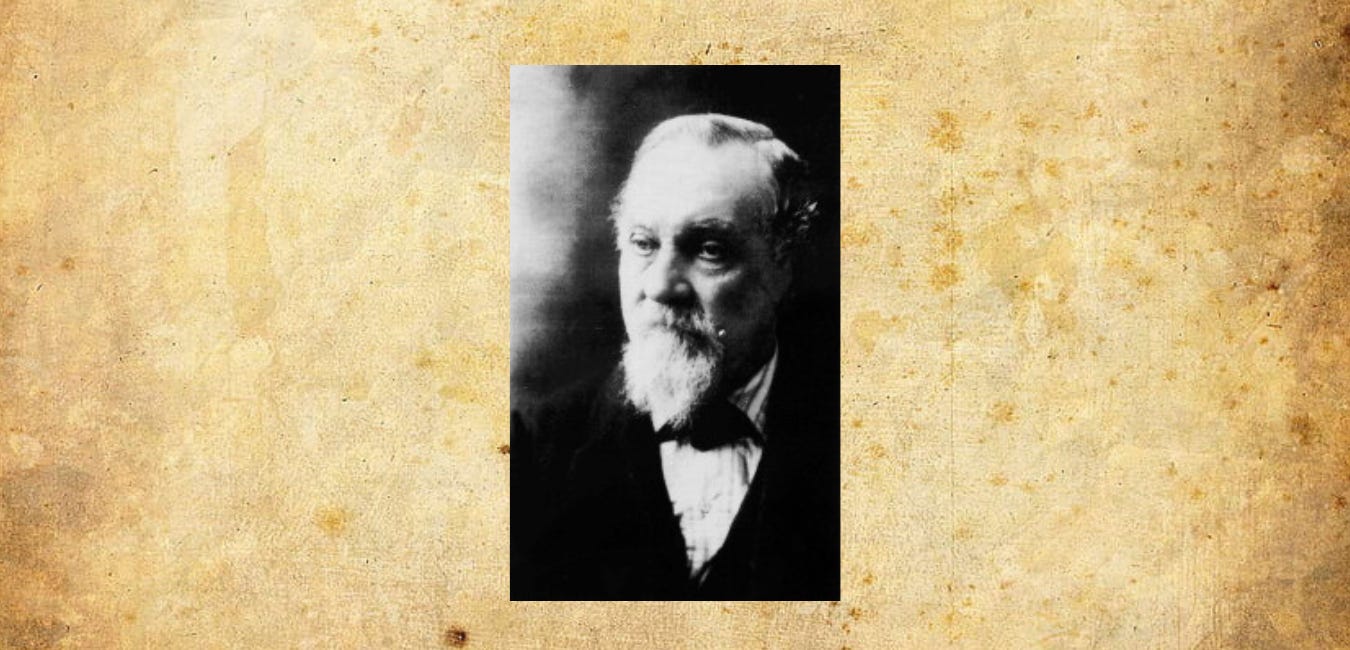
In the photo above is Captain William Moore, 1825–1909
Hearty dreamers and adventurers navigated the waterways, discovered gold, and built towns in Alaska. Captain William Moore was just such a man.
Moore was a steamship captain, businessman, miner, and explorer. He was known to his friends as “Buddy” and “The Flying Dutchman.”
He first came to what would become Skagway, Alaska, in the spring of 1887 as part of a Canadian survey expedition.
Note:
The original Alaska Tlingit people called the area Shgagwei, meaning “Home of the North wind”, or “Windy place.” The name Skagway is the English adaptation of that word.
There Was Going to be a Gold Rush
Because of spending time exploring with George Carmack, who we will take a look at in a moment, Moore had become convinced that a major gold strike would take place in the Canadian Klondike.
After first seeing the Skagway area, Moore returned in October 1887 to homestead. But he had much bigger plans.
He was going to establish a town and a wharf to accommodate steamships carrying miners and supplies. All of this so that he could cash in on the gold rush.
Note:
We mentioned George Carmack earlier.
Carmack went on to discover gold along a tributary of the Yukon River. The creek was called Rabbit Creek, but after Carmack’s gold strike, it was renamed Bonanza Creek.
So Captain Moore was right.
Yes, You Can Share This Edition
And when you do, your friends and family will be so happy that they will send you on an all-expense-paid, luxury 80-day adventure around the world in a hot air balloon… well, it could happen.
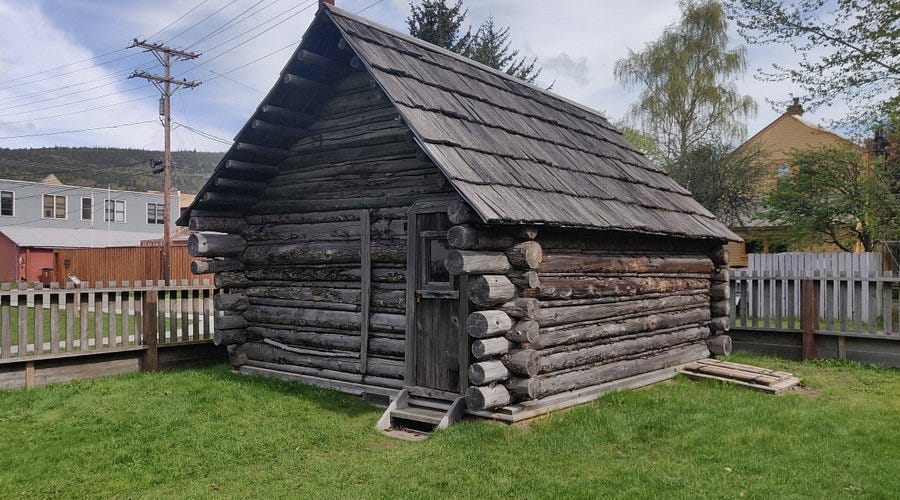
Pictured above is Captain William Moore’s original cabin, now the oldest building in Skagway.
Now, Moore set himself up to profit from the gold stampede that began in 1897.
Welcome to Mooresville
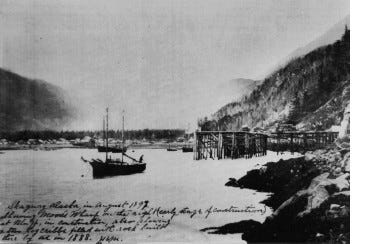
The photo above shows Moore’s Wharf on the right side.
Those arriving in the area found themselves at Moore’s wharf and in the town of Mooresville. His settlement became a boom town overnight, and the gateway to the Klondike Gold Rush. Moore was on a path to become very wealthy.
His Son, Ben Moore
When Captain Moore returned to the area to set up his town, he brought his adult son Ben with him.
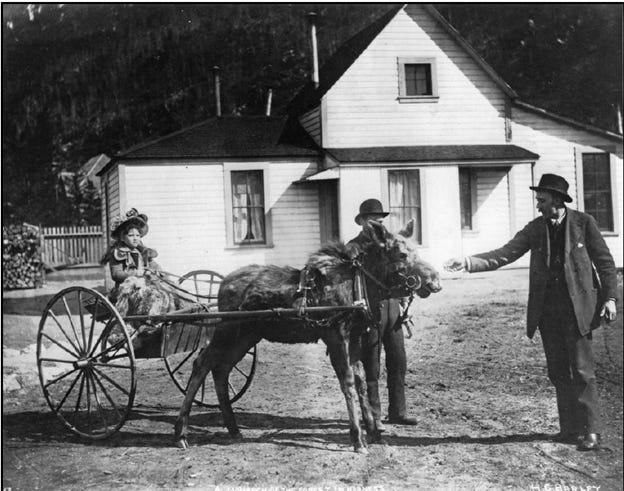
Ben Moore is on the right in the picture above. The moose was named Carnation.
Somehow, Ben got hold of a very young Moose. He named the moose Carnation and kept it in his yard. He also hooked the moose up so that it could pull a small two-wheel cart. Ben even showed off Carnation and the cart in a few parades.
Not So Fast Moore
The gold stampeders pushed Moore aside and took over the town.
And they decided to rename the town Skaguay. Notice the spelling. Later, the spelling of the name was changed to the current, Skagway.
While taking over, the stampeders literally pushed Moore aside.
A surveyor named Frank Reid plotted a new town layout. As a result, Captain Moore’s cabin had to be moved to a different location in the new town.
Note:
On July 8, 1898, Frank Reid, who had laid out the new town, would become famous for killing a con man known as Soapy Smith in a gunfight on Juneau Wharf in Skagway.
I’m Outa Here, Or Not
Captain Moore ended up leaving Skagway for a time. But not for long.
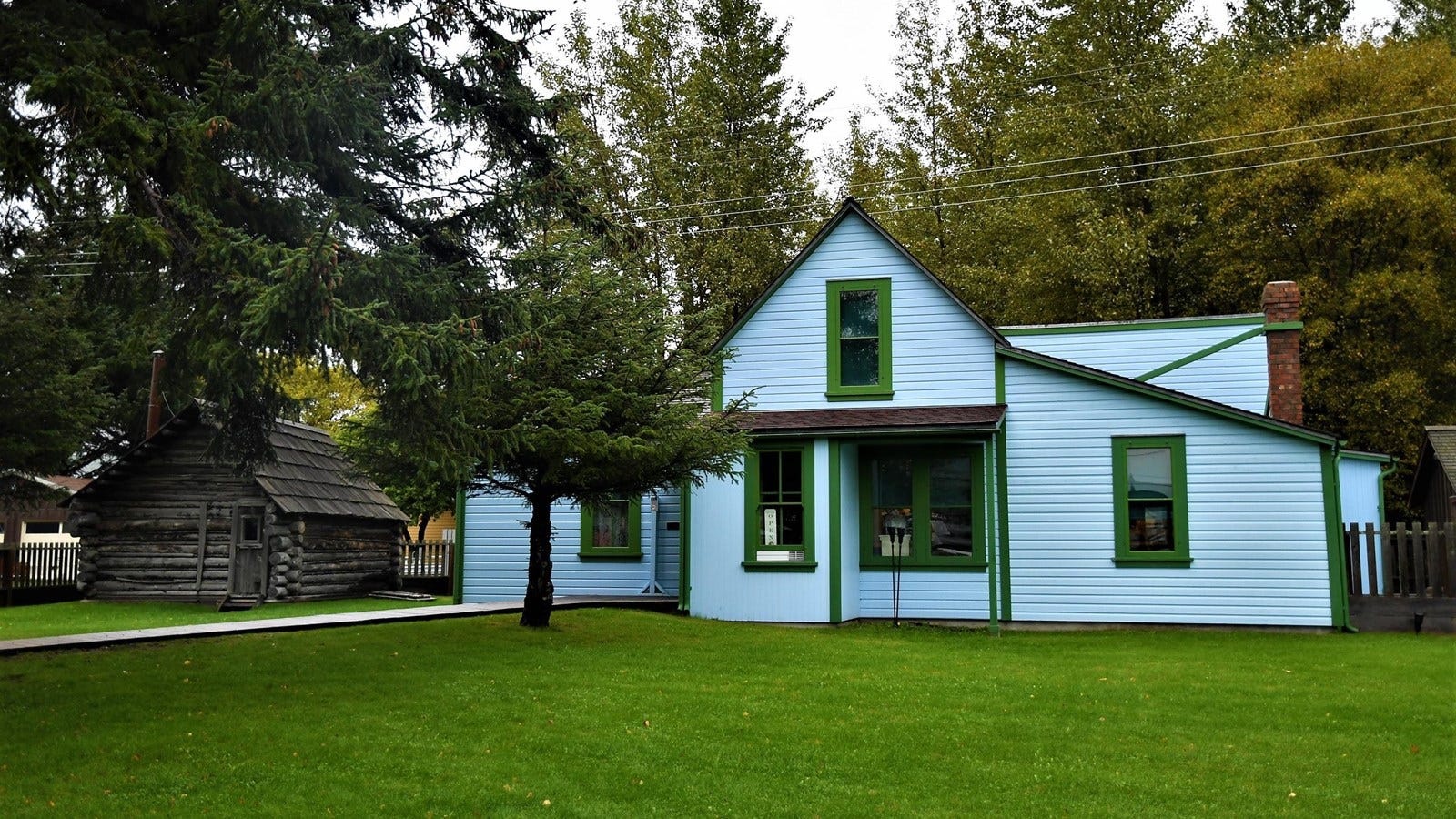
Pictured above is the new home Captain Moore built next to his original cabin.
When Moore returned to Skagway, he built a new house next to his original cabin. His new home included a second-story room that was set up like a pilot house on a steamship. That way, he could look out the window and watch the ships in the bay.
Gateway to the Klondike Gold Rush
Captain William Moore left Skagway for good in 1907.
He moved to Victoria, British Columbia, where he spent the remainder of his days.
Yes, Moore had realized his dream of establishing a town as the gateway to the Klondike Gold Rush. But his dream didn’t turn out as he had envisioned. Instead, he had lost fortunes along the way.
BONUS
Would you like to know more?
Take a look at William Moore, Steamship Captain, and discover.
From Our North Stars (that’s you)
From our Anchorage Seward Highway Memories.
Peter (Jerry Rose) recalls his memories:
“I was three years old (and living in Seward) when the highway opened. My dad was an active member of the Seward Chamber of Commerce at the time, so I’m guessing he participated in the ceremonies.
It was a big deal in those days to be able to make the trip from Seward to Anchorage and return. I recall that as work continued on paving roads into the Kenai Peninsula (where we had a cabin on Kenai Lake), that we often ended up having to follow a pilot car for a mile or two. I thought that was so cool! At night, road crews would leave smudge pots burning to mark the sides of the roads under construction.
In current videos I’ve watched, it’s amazing how the main highway has been widened and transformed to make it safer and more comfortable a drive. We always stopped at Moose Pass Inn for lunch or just to take a break from the drive. A mere 127 miles, but it passes through some of the most gorgeous countryside. I must have been about 7 at the time, but I vividly remember watching a Golden Eagle swoop down and grab a salmon from the nearby river! The last time I made the trip on the highway was 1984.”
Connect with Mike and Mary
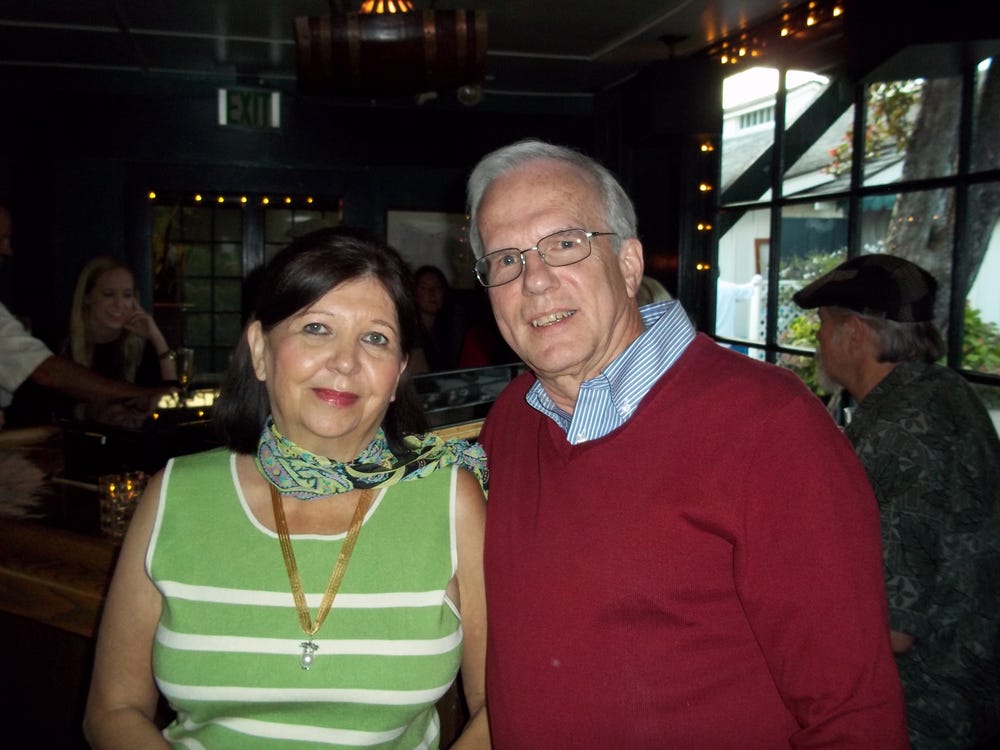
The story of Captain William Moore is a great example of the many adventurous pioneers who came to Alaska and paved the way for many others.
Do you have a comment?
You can also reply to this email.
Or you can Contact Us right now.
Until Next Time
Mike and Mary
Alaska Stories.com